
- You are here:
-
Home

- Dyno data
Interactive crossover kxf250
Valving Logic dyno tests of a kxf250 shim stack with an interactive crossover produces a crossover closure velocity of 25 in/sec. The PVP dyno data points show no evidence of crossover closure. However, the continuous damping force curve from Shim ReStackor calculations shows a subtle increase in slope at the crossover closure.
The Valving Logic dyno data includes separate measurements of the main piston, compression adjuster and the total combined damping force. The recorded data for each component of the shock closely tracks Shim ReStackor calculations for the configuration which also match the overall shock damping force.
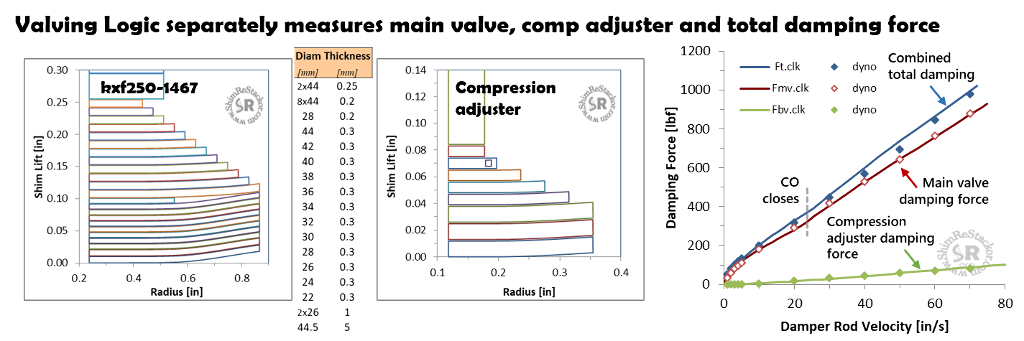
Valving Logic dyno test measures performance of each shock absorber component
Crossover tuning
Valving Logic demonstrated the effect of adding a crossover to a simple tapered shim stack. Adding the crossover makes the damping force softer everywhere, not just at low speed.
Tuning crossovers to produce the single effect of softer low speed damping requires multiple changes to the shim stack:
- The crossover position ...
- And diameter are adjusted to produce the desired low speed damping
- The crossover gap tuned to rpoduce the desired closure velocity
- The high speed stack reconfigured to produce the desired high speed damping
There is no algebraic equation to “design” a crossover. Crossovers are simply tuned by hacking around on each of the above four parameters to hit the target low and high speed damping force. Rapid calculations in Shim ReStackor make that easy.
Getting the crossover to work requires changing multiple parameters in the shim stack to obtain the single effect of softer low speed damping. Multiple simultaneous changes frustrates many tuners that only want to change “one thing at a time” when tuning a shim stack.
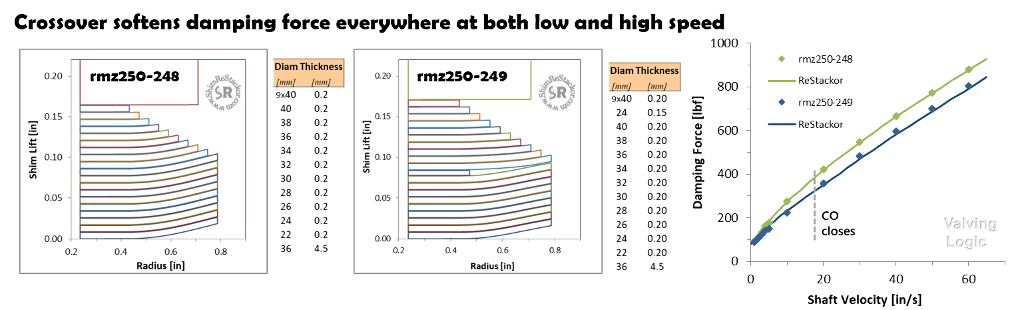
Controlling crossover low speed damping requires tuning the crossover position, diameter and high speed stack
MXScandinavia interactive crossover
Interactive crossovers use a shim diameter larger than the shim stack clamp. The larger crossover diameter transfers force from the face shims directly into the high speed stack forcing the high speed stack to begin deflection before the crossover closes. Interaction and deflection of the high speed stack before the crossover closes softens the crossover closure event.
MXScandinavia dyno testing on Thumper Talk evaluated the performance of an interactive crossover configuration
Shim ReStackor analysis of the configuration shows the crossover closes at a shaft velocity of 26 in/sec. Due to the shim stack configuration there is virtually no change in stack stiffness or damping force at the crossover closure confirming the dyno test results.
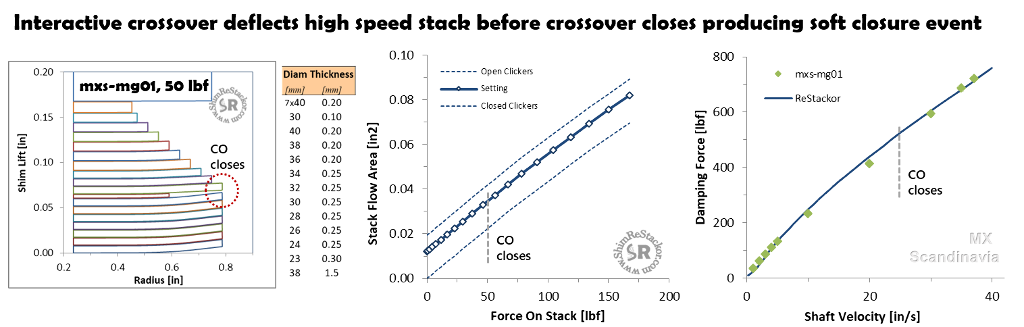
Interactive crossover produces a "soft" crossover closure event
Two stage crossover
Two stage crossovers have a similarity to split crossovers in spreading out the bend radius of the crossover shim shoulder. Valving Logic dyno testing of an rmz250 shock demonstrates performance of a two stage crossover.
Shim ReStackor analysis of the configuration shows the upper crossover gap closes first followed by closure of the lower crossover gap at shaft velocities near 37 in/sec.
The soft high speed stack used in the configuration produces little increase in damping force when the crossover gap closes.

Two stage crossover spreads out the crossover closure event